How to Commission a Hospital Mural: A Practical Guide for NHS Teams and Healthcare Spaces
My partner works in hospitals so I’ve actually visited the Warwick Hospital Costa a fair few times. I’ve been on the wards less often…There was a brief stint when I was 16 with a bout of food poisoning (definitely ate undercooked chicken but was too afraid to mention it to my new bf’s parents who were paying!) and then 20 years later for the birth of my son. I was in and out for a few weeks before the birth with pre-eclampsia so I got to know the maternity ward well.
Let’s face it…hospitals aren't always the most welcoming places. They're often busy, clinical environments, and for patients and their families, a hospital visit can sometimes feel overwhelming. There are beeping monitors with good beeps and bad beeps, busy clinical teams rushing around, technical kit attached to people monitoring stats and scientific jargon flying through the air (the number of acronyms my partner uses with his medic pals is beyond me - I’ll stick to drawing thanks!)
That being said, when there is an opportunity to introduce mural art into a hospital setting, the result can be transformative.
Whether it's a colourful illustration in a children's ward, a nature-inspired mural in a waiting room or artwork along a hospital corridor, murals can help make healthcare environments feel a little more approachable, welcoming and familiar. They take the edge off the serious-ness of the environment for those of us who might be a little bit tentative about a hospital visit or stay.
I've worked on murals for Worcestershire Royal Hospital, and am collaborating on a Winter exhibition with Coventry hospital. One of the things I find most interesting about creating artwork for healthcare spaces is working with the people and spaces a mural will live. Unlike a framed picture, a mural becomes part of the environment itself, interacting with the architecture and the people moving through it.
If you're thinking about commissioning a hospital mural, there are a few things worth considering before getting started. From budgets and funding to choosing an artist and understanding the practical requirements of working in a hospital, I've put together this guide to help you get your project off the ground.
Why commission a hospital mural?
Artwork can play an important role in making healthcare spaces feel more welcoming and engaging.
A hospital mural can introduce colour into an otherwise clinical environment, create points of interest and offer something positive for patients and visitors to focus on.
In children's wards, murals can help make unfamiliar surroundings feel friendlier and provide opportunities for distraction during difficult moments. In adult wards, waiting rooms and corridors, artwork can introduce elements of nature, local history or familiar places, helping create a connection to the world outside. They can offer a little escapism, something to look at instead of a phone.
Murals can also support wayfinding by giving different areas recognisable visual identities, making it easier for patients and visitors to navigate unfamiliar buildings.
One of the things I love about mural painting is that artwork doesn't have to be confined to a traditional rectangular frame. It can wrap around corners, respond to architectural features and become part of the space itself.
There are also some extra benefits of murals:
Reducing stress and anxiety: Research suggests that certain types of visual art, particularly nature-inspired imagery, can help create calmer healthcare environments.
Improving patient experience: Artwork can provide positive distraction, especially in waiting rooms and treatment areas.
Supporting wellbeing: Art can help make clinical spaces feel more welcoming and less institutional for patients, visitors and staff.
Where can hospital murals be installed?
Hospital murals can be created for all sorts of healthcare environments, and each space presents different opportunities. They can be painted directly onto a wall or installed as vinyl decals. Both of these can be wiped clean and kept sterile but have different access requirements for the installation. A painted mural takes longer to install so is best completed on a quiet ward or in a cordoned off area. It’s also useful to consider for new wards that are not yet open. A vinyl can be installed in less than a day so access to a bay or corridor is less disruptive. The area would only be out of bounds for a short while.
Children's hospital wards
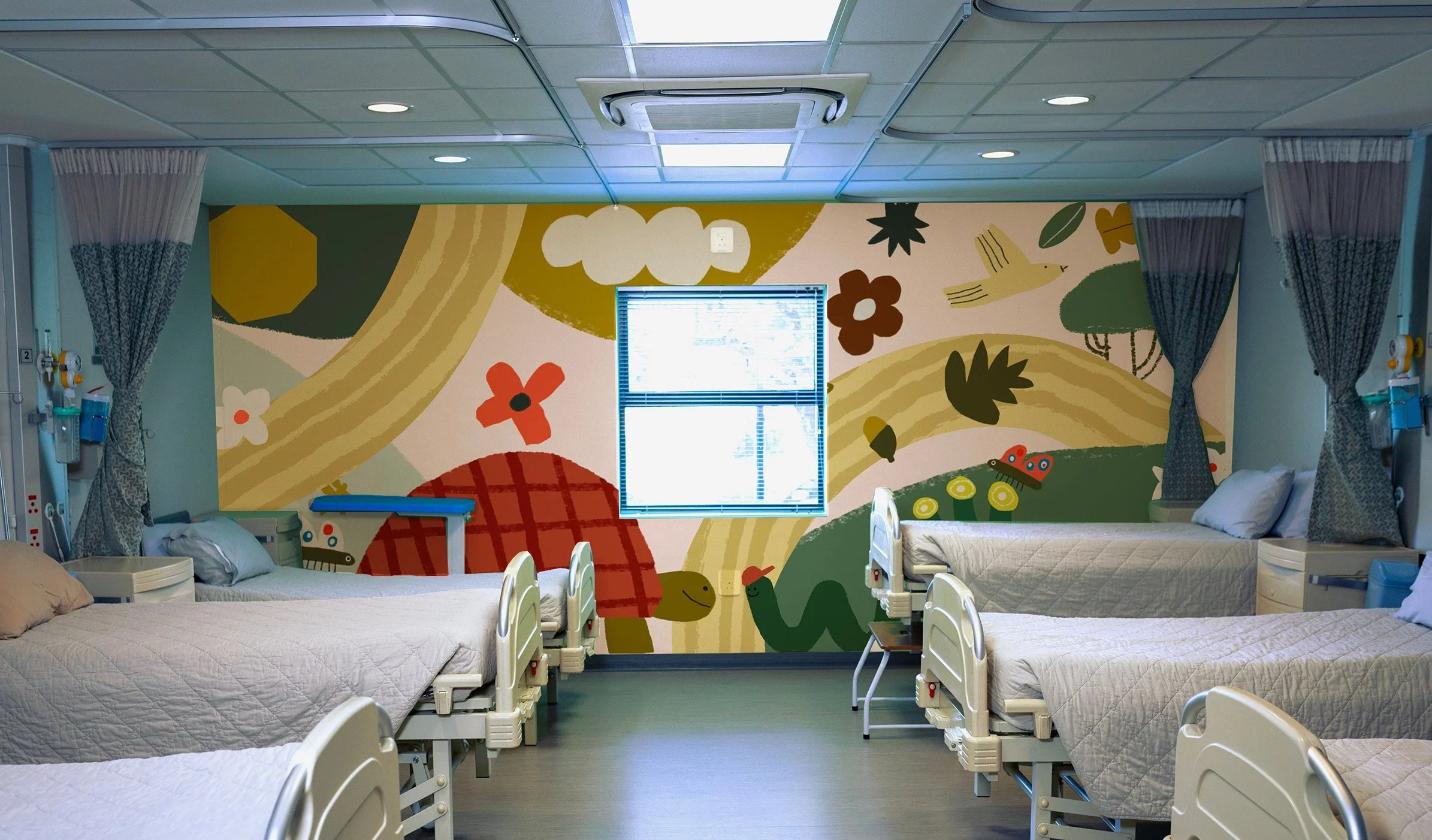
Children's wards are the perfect place for colourful wall art. Artwork can help make bays, private rooms, treatment areas and corridors feel less intimidating, while providing things for children and their families to discover. It may be tempting to ask for your favourite disney characters, but these are copywrighted. I create all my own unique designs and characters which make the space completely special and unique to your hospital.
Waiting rooms and reception areas
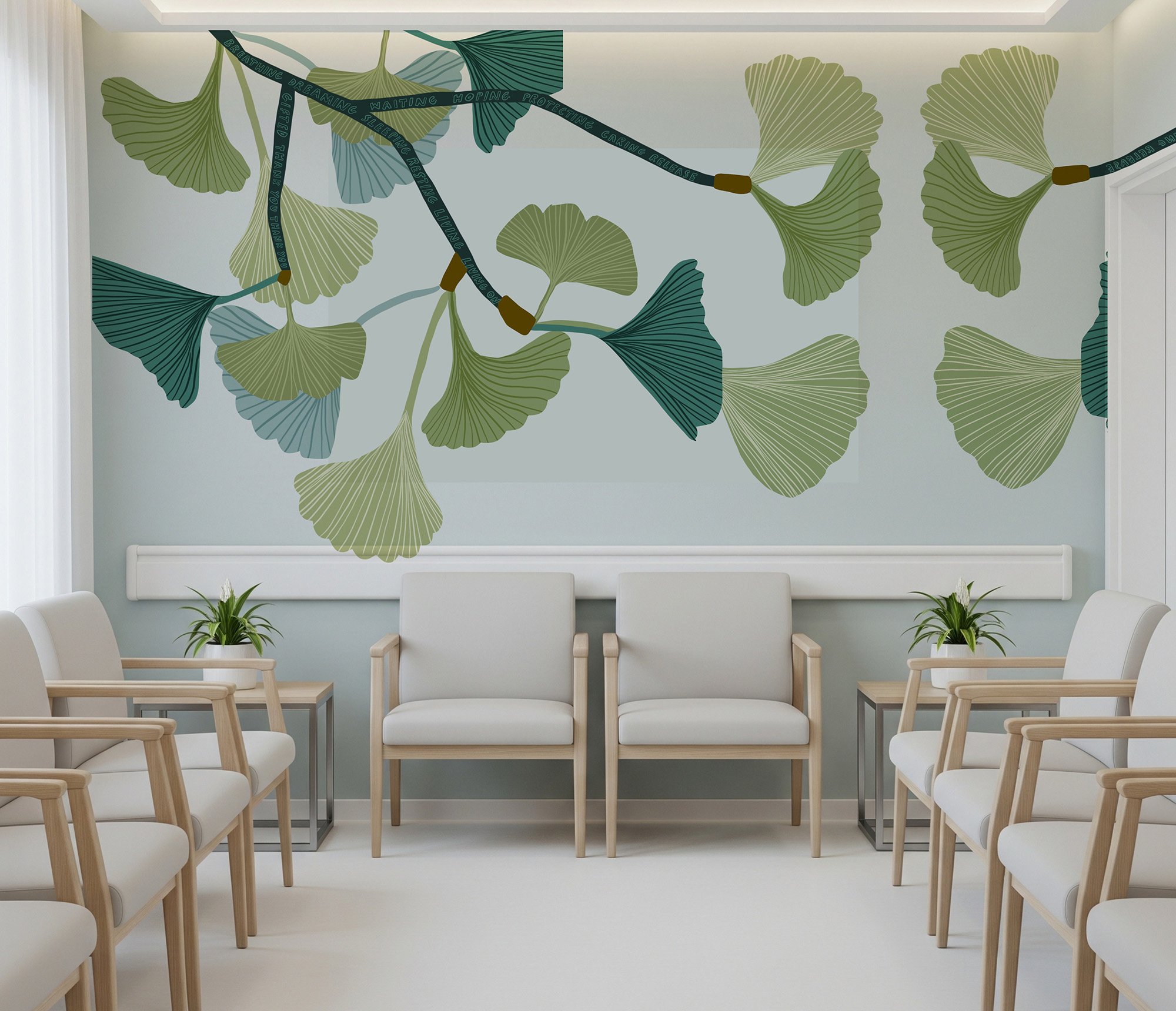
Waiting for an appointment or test results can be stressful. Murals can help make these spaces feel more welcoming and provide something interesting to look at while people wait.
Hospital corridors
Long corridors can feel repetitive and difficult to navigate. Murals can introduce colour, celebrate local identity and create recognisable landmarks throughout a building.
Staff areas
Healthcare staff spend long hours in demanding environments. Artwork in staff rooms and shared spaces can help create somewhere that feels more personal and restorative.
How do you commission a hospital mural artist?
There are several ways to commission artwork for a hospital, and the process doesn't have to be complicated!
When I created murals for Worcestershire Royal Hospital, I was commissioned through Severn Arts, who coordinated an artist call-out and interview process. Arts organisations can be brilliant at supporting projects like these, particularly when community engagement or a larger programme of work is involved.
Hospitals and NHS Trust charities can also approach artists directly to discuss a potential commission. You don't necessarily need to organise an open call or involve an external arts organisation to get a project started.
If you've seen an artist's work that you love, why not get in touch? Most artists will be happy to discuss your space, budget and ideas, even if you're only at the early stages of planning.
A direct conversation can be a great way to explore what's possible before developing a formal brief or seeking funding. You'll still need to follow your organisation's procurement and approval procedures, but commissioning artwork doesn't always need to involve a lengthy selection process.
Who needs to be involved in commissioning a hospital mural?
Hospital mural projects often involve several different people and departments.
Depending on the hospital, this might include ward managers, NHS charity teams, arts coordinators, estates departments, infection prevention and control teams, and patient representatives.
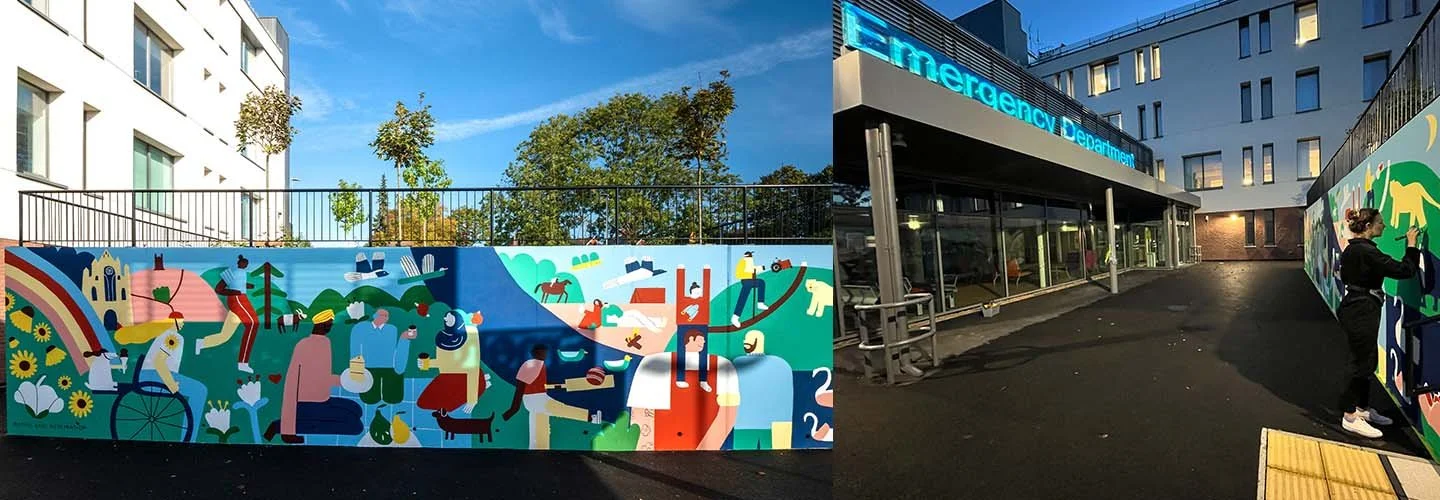
It's helpful to identify who needs to approve the project early on. When I developed the mural for Worcestershire Royal A&E I worked closely with the charity manager and the Health & Safety Team. We created a robust RAMS document to ensure the working environment would be safe for staff, patients and myself. This included considering where to wash brushes etc (I now take plenty of brushes and use cling film. This means I can take my dirty brushes home and reduces the risk of traipsing back and forward to a sink to wash up!) I also use brushes instead of spray paints which are much more friendly in a clinical setting.
It’s also important to include the estates department who will want to consider whether the proposed materials and installation method are suitable for the space. I have found that including a representative from all the involved parties from the start is helpful. Once I start generating visual mock-ups people will soon jump on board and start working out how we can get a project to work rather than if it is possible.
Hospital charities play an important role in helping to fund and coordinate artwork projects. Getting the right people involved from the beginning can make the commissioning process much smoother.
What should you include in a hospital mural brief?
You don't need a fully developed idea before approaching an artist.
In fact, involving an illustrator or mural artist early in the process can help you explore what might work best for your space.
There are a few details that will make it easier to discuss the project and help me develop an accurate quote.
A useful hospital mural brief should include:
Location: Which hospital building, department, ward or floor is the mural going to be?
Photographs: Clear images of the proposed wall and surrounding space.
Dimensions: Approximate width and height of the wall.
Access: Will we have access to a closed off space or need to work around a functioning space?
Audience: Who will use the space? Children, adults, families, staff or a mixture?
Purpose: What would you like the artwork to achieve?
Themes: Are there particular stories, places, colours or subjects you'd like represented?
Budget: Do you have funding confirmed or a budget you're working towards?
Timescale: Is there a particular completion date?
Practical considerations: Are there access restrictions or specific material requirements?
If you don't know all the answers yet, that's absolutely fine. A mural brief can develop through conversations with the artist and hospital team.
What practical considerations are involved in hospital mural painting?
As hospitals are working environments, before any artwork is installed, it's important to establish what is permitted within the space.
Infection prevention and cleaning
I will discuss with your H&S team my proposed paints and varnishes etc. I use water based paints as standard but can use eco friendly paints such as Little Green to comply with environmental standards. The paints all come with Safety Data Sheets which can be shared with the H&S and estates team. Vinyl decals are installed by a third party and can communicate directly with the hospital to verify compliance.
Access and installation
Some areas of a hospital may need to remain operational throughout installation. This can affect when painting takes place, how the work area is protected and whether certain spaces need to be temporarily closed. We can discuss this and make a plan based on your hospitals needs.
Durability and maintenance
Paints and vinyls can be wiped clean however it's worth discussing cleaning methods, expected lifespan, repair options and ongoing maintenance before deciding on materials.
Health and safety
An artist will work with you to create the RAMS. They can also share their public liability insurance documentation too.
How much does a hospital mural cost?
The cost of a hospital mural depends on the size of the artwork, complexity of the design, location and installation requirements. A small illustrated wall in a waiting area will usually require less time and materials than a large mural extending across several corridors or rooms.
As a guide, murals generally start from £1500 - £10000 upwards. This cost includes the time liaising with the teams, generating initial concepts, implementing feedback and revisions and installing the artwork itself. It is also possible to sometimes create some supporting material such as leaflets or colouring in sheets.
It's worth discussing your available budget with an artist early on. This allows them to suggest an appropriate scope and explain what's achievable. They can provide a rough quote which can help with funding targets.
How can you fund a hospital mural?
Not every hospital mural needs to be funded directly through a ward's existing budget.
There may be opportunities to seek support from other sources, including:
NHS hospital charities and fundraising teams.
Charitable trusts and foundations.
Local business sponsorship.
Community fundraising campaigns.
Donations from individuals or organisations.
Arts and wellbeing funding programmes.
Some projects may also fit within a hospital charity's wider aims around improving patient experience, supporting staff wellbeing or creating more welcoming healthcare environments.
What does the hospital mural commissioning process look like?
Here’s a run down of what you can expect from a commission process with me.
1. Initial conversation
We'll start by discussing the space, audience, budget and what you'd like to achieve.
Photographs, dimensions and any initial ideas are particularly helpful at this stage.
This could be online or in person. Sometimes in person is better as I can take photos and get a feel for a space, but that doesn’t always work so an online meeting is just as useful and it’s great to see a face rather than staring at emails!
2. Proposal and quotation
I'll prepare a quotation outlining the proposed work, design process, installation and expected timescale. I’ll share this with you and ask for feedback. If the quote isn’t aligning with your budget, don’t fret, please be open and let me know. There are always things that can be done to bring things more in line with your vision, such as adapting the level of detail within a design or modifying the scope of the work.
3. Research and design
This is where the artwork starts to take shape. Depending on the project, the design might draw on the local area, nature, stories from the community or ideas gathered from patients and staff.
I'll develop the illustration and share it for feedback. I include 2 rounds of revisions as standard. This means you can share the design with your wider team, funders or stakeholders and the wider hospital community can shape the design together. I only ask that the feedback is collected and delivered in 2 sessions. Feedback outside of the initial 2 rounds of revisions would be charged separately. This just prevents us from playing feedback tennis.
4. Approvals and preparation
Before installation, the relevant hospital teams will need to approve the design, materials and working arrangements. Once we have sign off, give me the go ahead and I’ll book an install time and date with you. If you’ve chosen to go for a vinyl, I will work with a vinyl partner to arrange for printing and together we will lock in the installation date with you.
5. Installation
Once everything is agreed, the artwork can be installed. Wooho, the really fun bit!
The time required will depend on the size of the mural, materials and access arrangements but hopefully by this stage we will all be singing from the same hymn sheet so there won’t be any surprises. If for some reason it looks like I’m going to take much longer to install the design than first anticipated, I will let you know as soon as I know. This is rare but good to know!
6. The finished mural
Once it’s finished we can celebrate - seriously I do think a little unveiling is worth organising if possible to appreciate the achievement and put a little mark in the sand to say - we did that!
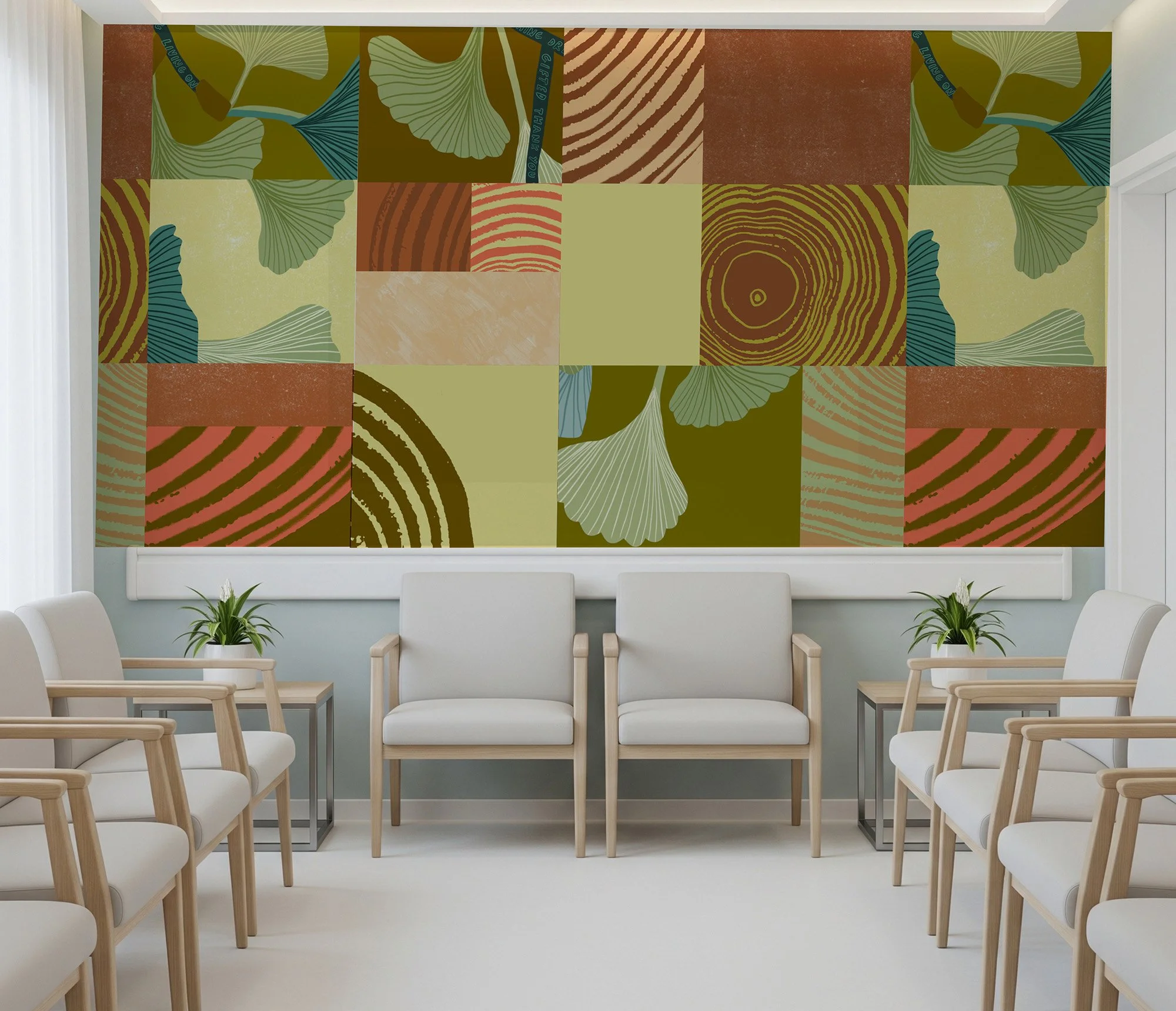
My experience creating hospital murals
I love creating illustrations that celebrate nature, people and places, bringing colour and character into spaces that can otherwise feel quite functional. Unlike a framed picture, a mural becomes part of the environment itself. It can respond to the shape of a room, work around architectural features and help give a space its own identity.
The best part is seeing the reactions of the patients, staff, children and families who use the space. I think art is still a little unexpected in a hospital setting so seeing that a team have put the effort into creating a warm welcoming space is such a pleasure.
Ready to commission a hospital mural?
Whether you're planning a children's ward mural, looking to brighten a hospital corridor or exploring ways to make a waiting area more welcoming, I'd love to hear about your project.
I work with NHS teams, charities and organisations to create bespoke murals and illustrations that respond to the spaces they're designed for.
You don't need to have a complete brief or confirmed budget before getting in touch. I'm always happy to have an initial conversation about what might be possible.
I can't wait to hear about your hospital mural project! Get in Touch HERE.